


Chrysler, Dodge & Jeep OBD2 readiness drive cycle
If the readiness monitors on a Chrysler, Dodge or Jeep still show Not Ready after clearing fault codes, disconnecting the battery or repairing an emissions-related problem, the vehicle may need to experience specific operating conditions before those monitors can complete.
This is where many people get frustrated: simply driving 50 or 100 miles does not guarantee that every monitor will switch to Ready.
The PCM is waiting for the right combination of engine temperature, fuel level, road speed, load, cold-start conditions and operating time before it runs each self-test.
Clearing DTCs or disconnecting the battery normally resets OBD2 readiness information. Once you begin trying to complete the monitors, avoid clearing codes again unless diagnosis requires it.
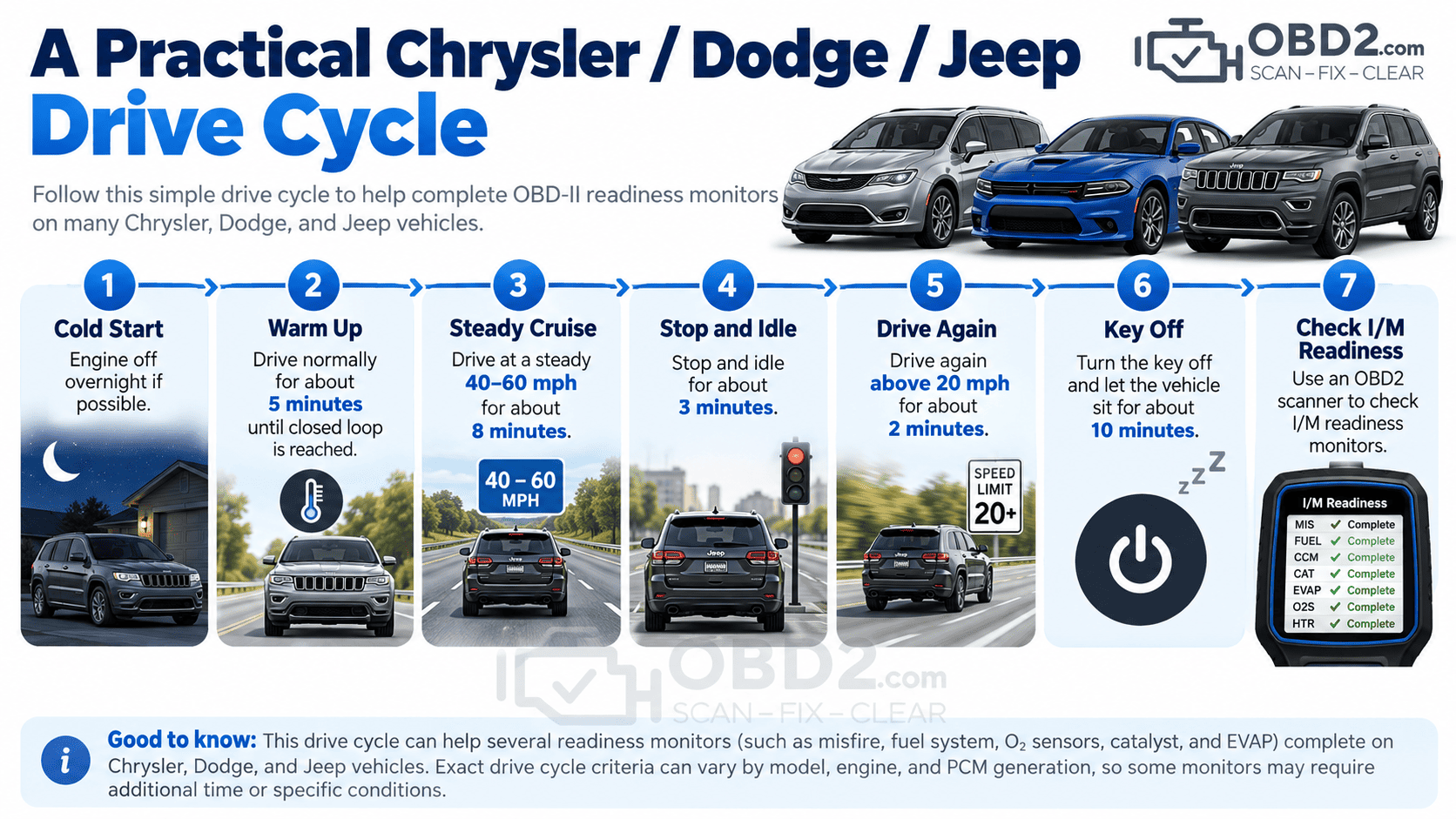
A practical Chrysler / Dodge / Jeep drive cycle
A commonly used Chrysler-family drive sequence is:
- Begin with the Check Engine Light off and, when possible, a cold engine.
- Start the engine and allow it to warm for approximately 5 minutes, until normal closed-loop operation is reached.
- Drive with a relatively steady throttle between approximately 40 and 60 mph for about 8 minutes.
- Come to a stop and allow the engine to idle for approximately 3 minutes.
- Drive again at a steady speed above approximately 20 mph for about 2 minutes.
- Switch the engine off and leave the ignition off for approximately 10 minutes.
- Reconnect your scanner and check the I/M Readiness status.
This sequence can help several monitors complete, but it should not be treated as a universal recipe that works on every Chrysler, Dodge, Jeep or Ram vehicle.
Different PCM generations, engines and emissions systems use different enabling criteria. If one specific monitor remains incomplete, it is usually more useful to understand what that monitor is waiting for rather than repeating the same drive cycle over and over.
Always perform road-driving portions safely and legally, using traffic conditions that allow steady-speed operation without creating a hazard.
What readiness monitors actually mean
OBD2 readiness monitors are self-tests carried out by the engine management system to check emissions-related systems.
Depending on the vehicle, the list can include:
- catalyst monitor;
- oxygen sensor monitor;
- oxygen sensor heater monitor;
- EVAP system monitor;
- EGR monitor;
- misfire monitor;
- fuel system monitor;
- secondary air monitor where equipped.
Some of these tests operate continuously. Others only run when a very specific set of conditions is met.
This distinction explains why one vehicle can show almost every monitor as Ready after a short drive while another can be driven for days with one stubborn monitor still incomplete.
Why a monitor shows Not Ready
A monitor may remain incomplete simply because the PCM has not yet had the opportunity to run that test.
Common reasons include:
- the battery was recently disconnected;
- DTCs were erased with a scan tool;
- the PCM was replaced or reprogrammed;
- the required cold-start or soak conditions have not occurred;
- fuel level is outside the range needed for an EVAP test;
- the vehicle is mainly used for short trips;
- steady-speed driving conditions have not occurred;
- a pending or stored fault is preventing the test from running;
- a sensor value is outside the monitor’s enabling criteria.
That last point is important. A monitor can stay Not Ready even when the vehicle appears to drive normally.
For example, an engine that runs slightly too cool because of thermostat operation may never satisfy the temperature conditions required by a particular emissions test.
Check the vehicle before repeating the drive cycle
Before spending another hour driving, check what the PCM is already telling you.
- Scan for confirmed and pending emissions-related DTCs.
- Check which monitors are actually incomplete.
- Verify that the MIL / Check Engine Light operates normally during the bulb check.
- Confirm that the engine reaches normal operating temperature.
- Avoid clearing codes again unnecessarily.
- Review the current I/M Readiness screen before starting.
Only the monitors showing Incomplete or Not Ready need additional drive conditions.
Why the EVAP monitor often takes the longest
The EVAP monitor is one of the most common reasons a Chrysler-family vehicle remains Not Ready.
Unlike a test that can run during normal cruising, EVAP testing may depend on conditions that cannot simply be created by pressing the accelerator or driving farther.
Depending on the vehicle and PCM strategy, important conditions can include:
- a prolonged engine-off or cold-soak period;
- an appropriate fuel level;
- similar intake-air and coolant temperatures at startup;
- suitable ambient temperature;
- normal purge-system operation;
- no EVAP-related DTCs.
Some Chrysler procedures involve an overnight soak of approximately 8 hours. Certain systems may also require the fuel level to remain roughly between 15% and 85%.
The exact values are vehicle-specific, but the principle is useful: if the tank is nearly empty or completely full, or if the vehicle never sits long enough to become cold, the PCM may postpone the EVAP test.
Repeatedly clearing codes makes the situation worse because it starts the readiness process again from the beginning.
Catalyst and oxygen-sensor monitors
The catalyst monitor typically needs the engine fully warmed and operating in closed loop.
Several minutes of relatively stable road speed and engine load may then be required.
A useful approach is to:
- allow the engine to reach normal temperature;
- drive smoothly;
- maintain a steady road speed where conditions permit;
- avoid unnecessary heavy acceleration;
- avoid constantly changing throttle position.
During this period, the PCM can compare upstream and downstream oxygen-sensor activity and evaluate catalyst performance.
Oxygen sensor monitor
The oxygen-sensor monitor generally depends on closed-loop fuel control, normal coolant temperature, stable sensor operation and suitable engine speed and load.
Fuel-control faults or oxygen-sensor faults may prevent the monitor from completing.
Oxygen sensor heater monitor
The heater circuits are monitored when the PCM commands them to operate.
On some Chrysler strategies, information is finalized or stored after the ignition is switched off. This is one reason the key-off period at the end of a drive cycle can matter.
EGR, misfire and fuel-system monitors
EGR monitor
On vehicles equipped with EGR, the PCM may evaluate EGR operation during conditions such as:
- closed-throttle deceleration;
- idle;
- specific engine-speed ranges;
- specific manifold-pressure conditions;
- specific throttle-position conditions.
This means that steady highway cruising alone may not give the PCM everything it needs to run the EGR test.
Misfire monitor
The misfire monitor is generally considered a continuous monitor, but some Chrysler PCM strategies rely on learned crankshaft-position information for accurate misfire detection.
After a battery disconnect or PCM reset, certain learned values may need to be rebuilt.
If a crankshaft-position or relearn-related fault code is present, diagnose that issue before concentrating only on readiness status.
Fuel-system monitor
The fuel-system monitor evaluates whether the PCM can maintain the expected air/fuel mixture using oxygen-sensor feedback and fuel trims.
Conditions that may interfere with it include:
- vacuum leaks;
- incorrect fuel pressure;
- oxygen-sensor faults;
- air-metering problems;
- engine-temperature faults;
- fuel-trim DTCs.
There is no magic number of miles
A readiness drive cycle is about conditions, not mileage.
A vehicle can travel hundreds of miles without completing a particular monitor if the required conditions never occur.
Another vehicle may complete several monitors in a single trip because the temperature, load, speed and soak conditions happen to be correct.
So if someone tells you that a Chrysler monitor will always reset after “50 miles” or “100 miles,” treat that as a rough anecdote rather than a diagnostic rule.
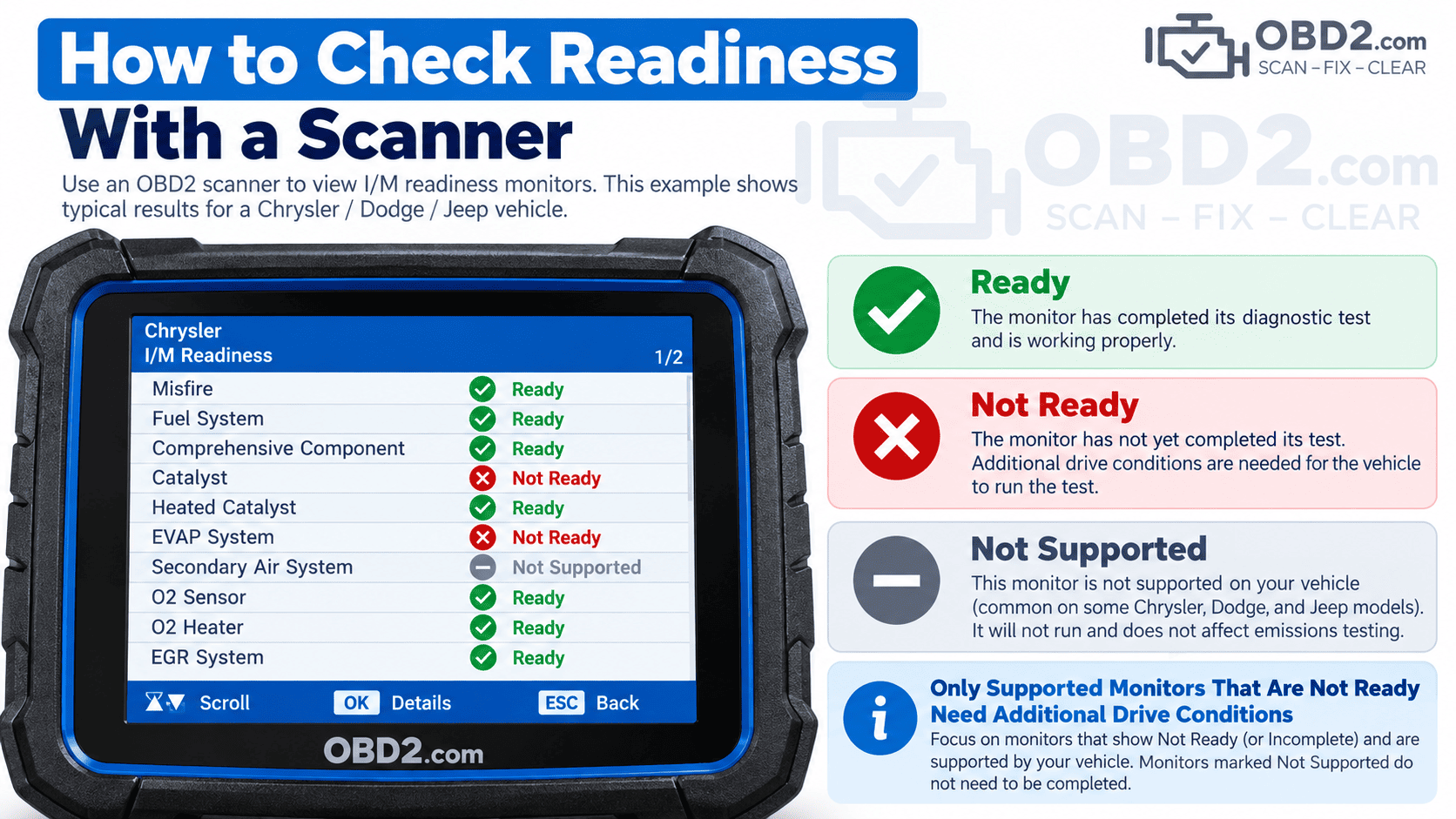
How to check readiness with a scanner
Connect a compatible OBD2 scanner and select the function usually called:
- I/M Readiness;
- Inspection / Maintenance Readiness;
- or simply Readiness Monitors.
The status may appear as:
- Ready;
- Complete;
- Not Ready;
- Incomplete;
- Not Supported.
Not Supported is not the same as Not Ready.
If the vehicle does not use a particular monitor, there is nothing to complete. Only supported monitors that remain incomplete are relevant.
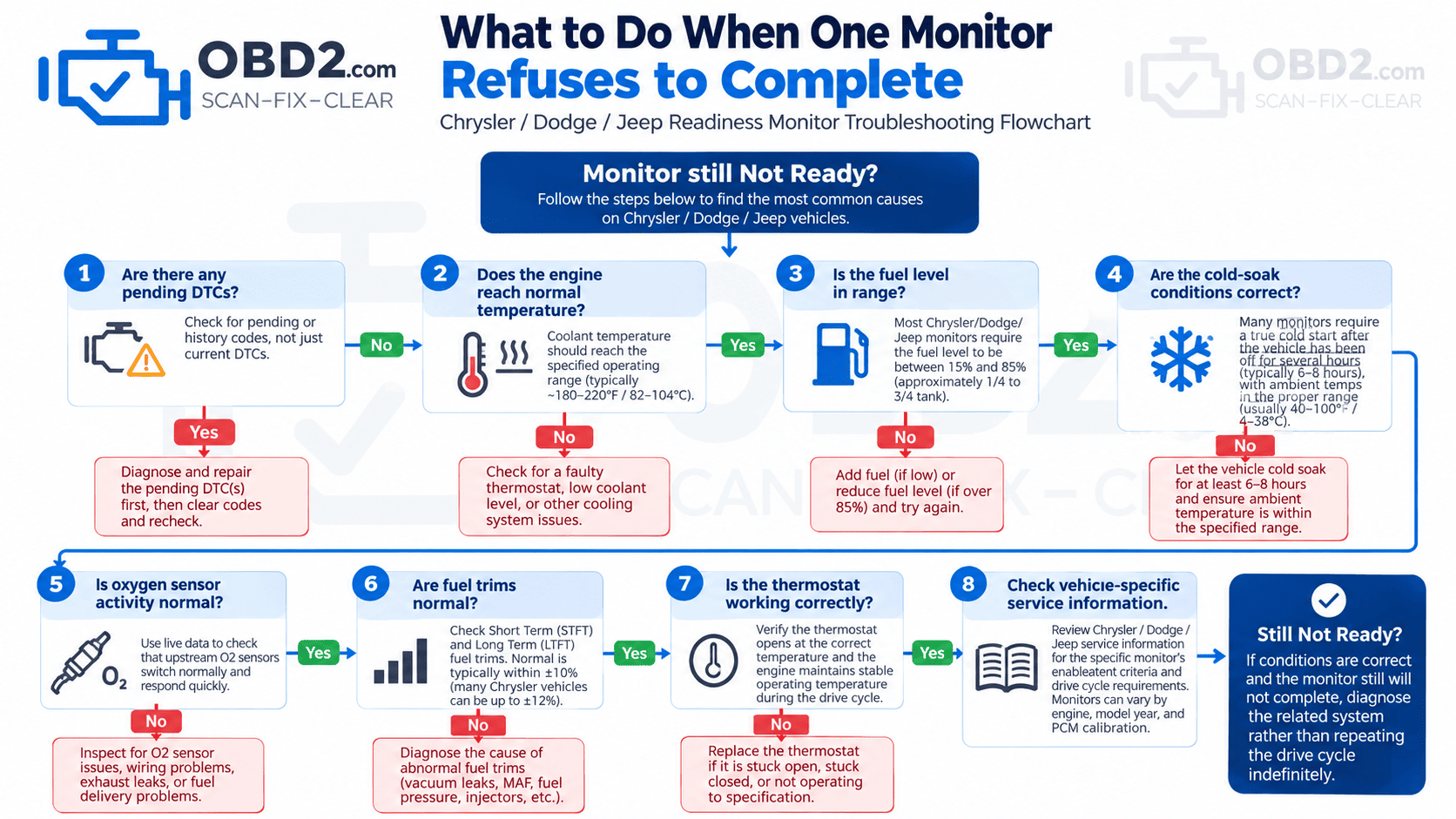
What to do when one monitor refuses to complete
If the same monitor remains Not Ready after several appropriate trips, stop repeating the drive cycle blindly.
Look at the data that controls that monitor.
Useful checks can include:
- pending DTCs;
- engine coolant temperature;
- intake-air temperature;
- fuel level;
- short- and long-term fuel trims;
- oxygen-sensor activity;
- EVAP system faults;
- thermostat operation;
- vehicle-specific monitor enabling criteria.
For example, if the coolant temperature never reaches the value expected by the PCM, another 100 miles of driving may change nothing. The correct next step is diagnosis, not more mileage.
Clearing codes resets the process
Clearing emissions-related DTCs with a diagnostic scanner normally resets OBD readiness information as well.
Disconnecting battery power can have the same effect.
After a repair, clear the codes when appropriate, then allow the vehicle to complete its self-tests.
If you repeatedly erase codes each time you check the vehicle, the PCM never gets a chance to build a complete set of readiness results.
Does Ready mean the vehicle has no problems?
No.
A Ready status only means that the PCM successfully completed that particular self-test since the last reset.
It does not mean that every component on the vehicle is fault-free, and it does not replace diagnosis when symptoms or fault codes are present.
Chrysler readiness drive cycle FAQ
How long does it take for Chrysler readiness monitors to become Ready?
There is no fixed time or mileage. Some monitors may complete during one suitable trip, while EVAP and other non-continuous monitors can require a cold soak or several driving events.
Can I complete the monitors with the check engine light on?
An emissions-related fault can prevent one or more monitors from running. Diagnose active faults before repeatedly attempting drive cycles.
Why is EVAP still Not Ready?
The EVAP monitor may be waiting for the correct fuel level, temperature, engine-off soak time or other enabling conditions.
Will disconnecting the battery make the monitors Ready?
No. Battery disconnection normally resets readiness information, meaning the monitors must run again.
Can a scanner force a monitor to Ready?
A normal OBD2 scanner can display readiness status, but it cannot simply change an incomplete emissions monitor to Ready. The PCM must successfully complete the corresponding self-test.
Related OBD2 resources
A final vehicle-specific note
Chrysler, Dodge, Jeep and Ram vehicles cover many generations of PCMs, engines and emissions systems.
The exact monitor-enabling criteria can therefore differ by model, engine and model year.
If one monitor remains difficult to complete, use the service information for the exact vehicle and monitor rather than assuming that one universal Chrysler drive cycle applies to every application.
