


Chrysler OBD1 diagnostics: SCI, CCD and pre-OBD2 scan tools
Connecting a scan tool to an older Chrysler, Dodge or Jeep can be very different from diagnosing a modern OBD2 vehicle.
Before diagnostic systems became standardized, Chrysler used its own connectors, communication methods and scan-tool requirements. These earlier systems are commonly grouped under the informal term OBD1, even though there was no single universal Chrysler OBD1 standard covering every model and year.
Historical versions of OBD2.com documented professional scan-tool hardware for these vehicles. This guide replaces those unavailable legacy resources with a practical explanation of how Chrysler’s pre-OBD2 diagnostics worked and why modern generic OBD2 equipment cannot automatically communicate with them.
There is no single Chrysler OBD1 connector, pinout or communication procedure that applies to every pre-OBD2 vehicle. Always identify the exact model, year, engine, controller and diagnostic system before connecting test equipment.
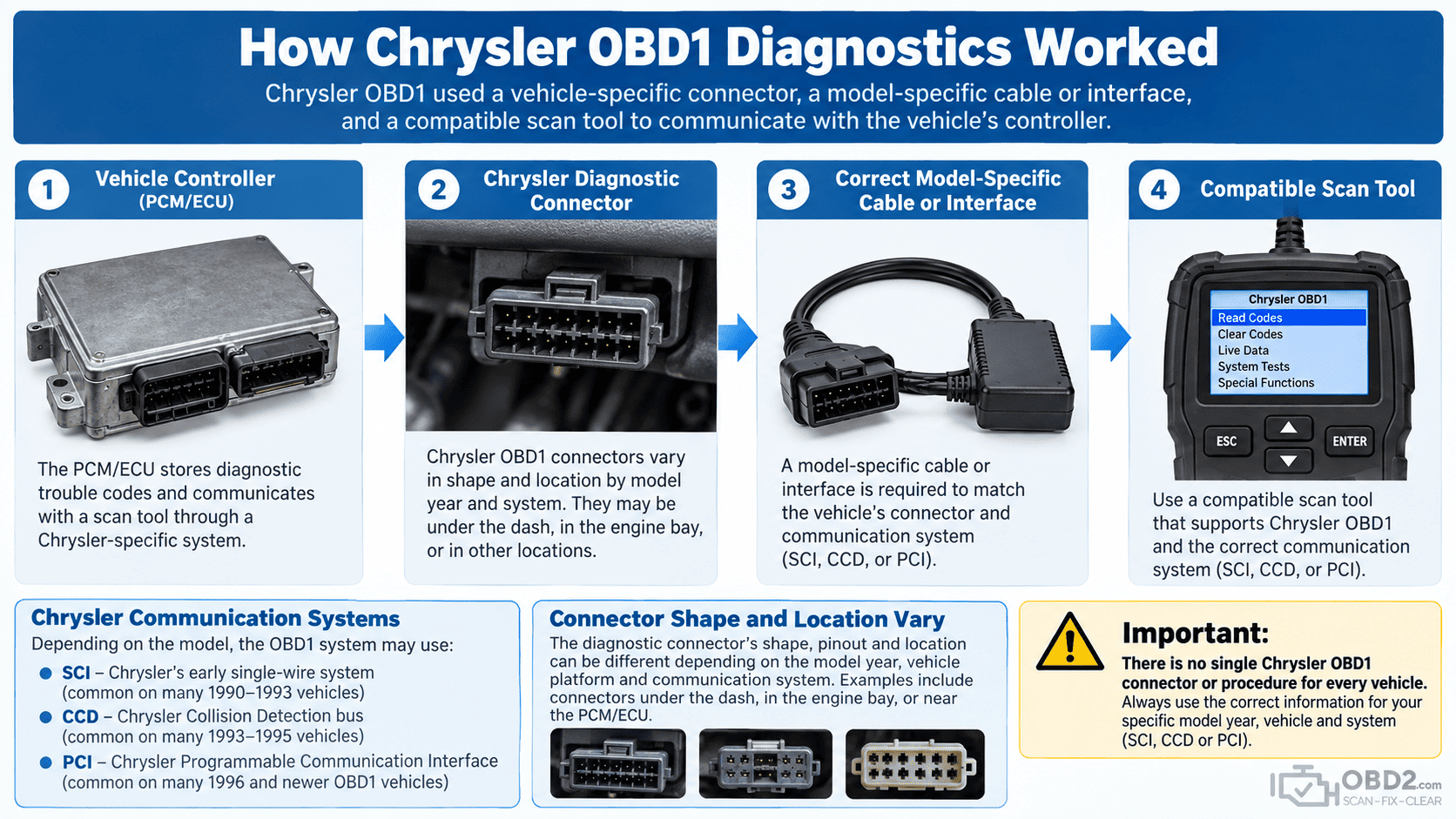
What Chrysler OBD1 actually means
OBD1 is a convenient modern label for the diagnostic systems used before standardized OBD2 became widespread.
Unlike OBD2, these earlier systems were largely designed by each manufacturer. Chrysler could therefore choose its own connector, communication network, trouble-code format and diagnostic procedures.
That lack of standardization is the main reason diagnosing an older vehicle can be more complicated than simply finding an adapter cable.
Depending on the model and generation, differences could include:
- diagnostic connector shape and location;
- communication protocol and electrical signalling;
- fault-code numbering and definitions;
- required scan-tool cable or adapter;
- which controllers could actually communicate with a scan tool.
Two Chrysler vehicles built only a few years apart can therefore require different diagnostic hardware even though both are casually described today as “OBD1.”
SCI was an important Chrysler diagnostic link
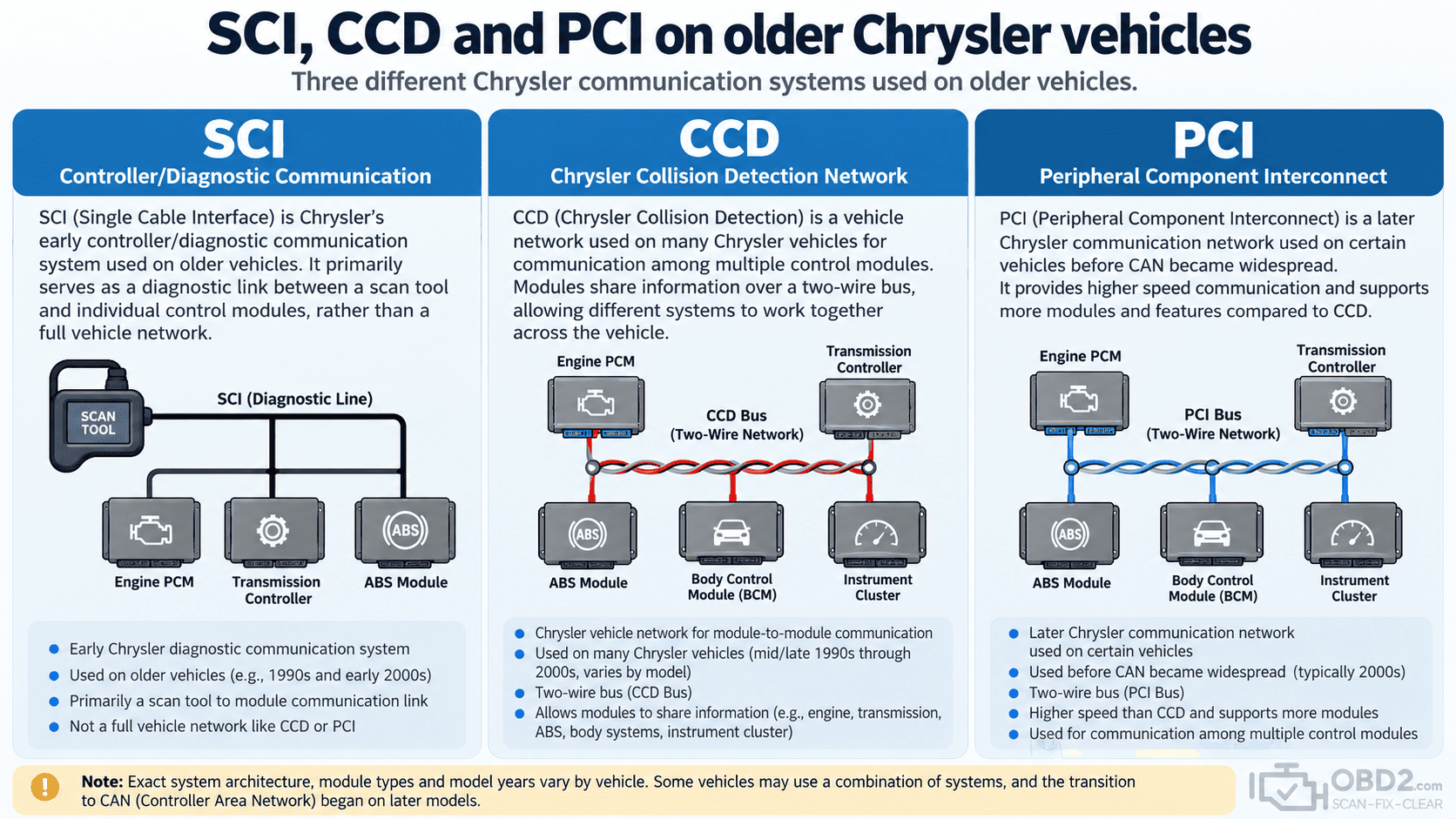
Many older Chrysler vehicles used SCI — Serial Communication Interface.
SCI provided a communication path between a compatible diagnostic tool and a vehicle controller such as the engine or powertrain control module.
This is one of the biggest traps when trying to use modern equipment on an older Chrysler.
A cable may physically connect a modern scanner to an older diagnostic socket, but changing the plug shape does not change the communication protocol.
If the scanner does not understand Chrysler SCI, it still cannot communicate correctly with the controller.
CCD was a vehicle network, not just a scan-tool connection
Chrysler also used the CCD — Chrysler Collision Detection bus on many vehicles.
CCD allowed electronic modules around the vehicle to exchange information with one another.
This is different from thinking of vehicle diagnostics as a single wire between a scanner and the engine ECU. An older Chrysler can contain several controllers communicating across a vehicle network while also providing a separate diagnostic path for certain functions.
A capable factory-level or professional scan tool therefore needed to understand not only the connector but also the network and controller it was trying to reach.
PCI appeared on later Chrysler vehicles
Later Chrysler platforms also used PCI — Programmable Communication Interface on certain systems before CAN became widespread.
This created an important transition period.
A vehicle might already look relatively modern and may even use standardized OBD2 for emissions-related engine diagnostics, while other modules still communicate through Chrysler-specific networks.
That is why vehicle year alone is not always enough to determine diagnostic compatibility.
Why OBD2 changed vehicle diagnostics
OBD2 introduced a much higher level of standardization.
A compliant vehicle provides standardized emissions-related diagnostic access through the familiar 16-pin Data Link Connector. This allows a generic OBD2 scanner to retrieve certain information across many different vehicle brands.
Pre-OBD2 Chrysler diagnostics were far less universal.
A technician might need a dedicated connector, Chrysler-specific cable, suitable scan tool and service information for the exact controller being diagnosed.
This is why modern OBD2 diagnosis often feels simple by comparison: much of the physical connection and basic communication layer has already been standardized.
Can a modern OBD2 scanner read Chrysler OBD1?
Usually not through generic OBD2 functionality alone.
The scanner must explicitly support the older Chrysler communication system and use an appropriate physical interface.
This distinction matters because adapter cables are often misunderstood.
An adapter can change one connector shape into another. It does not automatically teach a scanner how to speak SCI, CCD or another manufacturer-specific protocol.
If the scan tool’s hardware and software do not support the required system, an adapter alone will not solve the problem.
Trouble codes on older Chrysler vehicles
Diagnostic Trouble Codes on pre-OBD2 Chrysler vehicles should be interpreted using information for the exact system being diagnosed.
Depending on the vehicle generation, codes may be retrieved with a compatible scan tool, through a manufacturer-specific procedure or, on certain vehicles, through an indicator-light flash sequence.
Modern standardized P-codes should not simply be applied to an older Chrysler code because the numbers happen to look similar.
The diagnostic system must first be identified, then the code definition checked against information appropriate to that year, engine and controller.
What a Chrysler OBD1 scan tool could do
Professional manufacturer-compatible tools could offer much more than a simple fault-code display.
Depending on the controller and vehicle, available functions could include code reading and clearing, sensor values, switch status, controller identification, system-specific tests and certain actuator commands.
Not every module supported the same functions. The diagnostic capability depended on the combination of vehicle, controller, scan-tool software and cable.
This is similar to modern diagnostics in one important respect: the fact that a tool can communicate with one module does not mean it can perform every possible function on the vehicle.
Identify the connector before connecting anything
With older diagnostic systems, connector identification is part of the diagnosis.
Before plugging in test equipment, establish the exact vehicle and determine which diagnostic system is actually present.
- Confirm the model year, model and engine.
- Identify the controller or system you need to diagnose.
- Locate the correct diagnostic connector.
- Verify its pinout and communication method.
- Choose a scan tool and cable designed for that system.
- Only then attempt communication.
This is especially important when working with old or undocumented adapter cables. Incorrect wiring can damage the scan tool, the diagnostic interface or vehicle electronics.
The 1996 transition does not make every system identical
In the United States, standardized OBD2 became mandatory for 1996 model-year light-duty vehicles.
That greatly simplified emissions-related engine diagnosis, but it did not instantly replace every manufacturer-specific network used elsewhere in the vehicle.
A Chrysler from the transition era can therefore support generic OBD2 engine diagnostics while still relying on manufacturer-specific communication for other modules.
This pattern continued into later vehicles as well: standardized OBD2 and manufacturer-level diagnostics coexist rather than being the same thing.
Can an ELM327 read Chrysler OBD1?
A normal ELM327 setup is designed around OBD2 communication protocols.
It should not be assumed to support older Chrysler SCI or other pre-OBD2 systems.
Specialized interfaces and software may exist for particular older Chrysler platforms, but compatibility has to be established for that specific vehicle.
If an ELM327 works perfectly on a newer Chrysler through the standard 16-pin connector, that does not prove it will communicate with a pre-OBD2 model through an adapter.
Diagnosing a no-communication problem
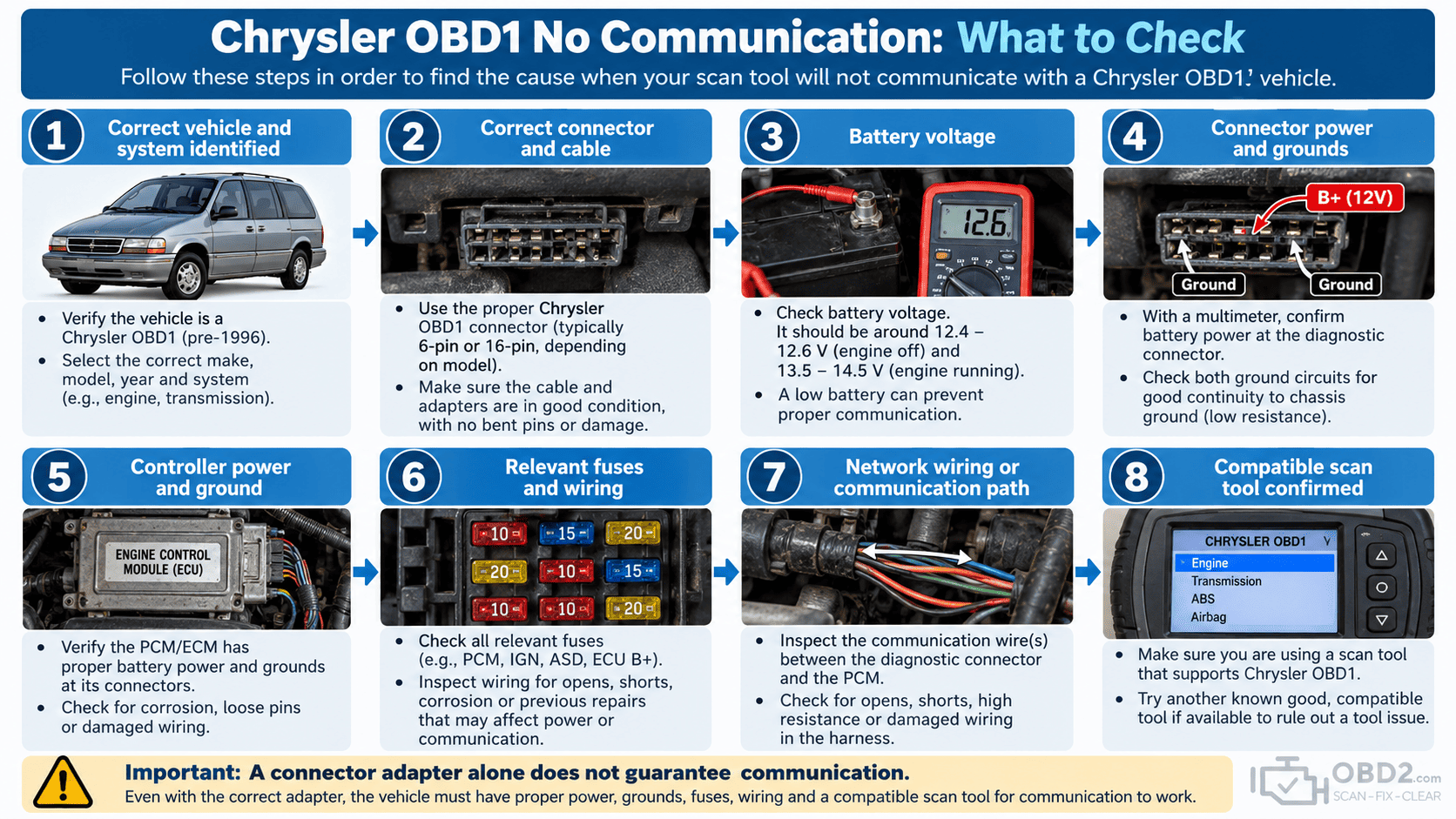
If you already have a scan tool known to support the vehicle but it still will not communicate, start with the basic electrical and network checks rather than immediately blaming the ECU.
Useful checks include:
- vehicle battery voltage and controller power supplies;
- diagnostic connector power and grounds;
- relevant fuses and damaged connector terminals;
- correct cable, adapter and vehicle selection in the scan tool;
- network wiring and controller power or ground faults.
The fact that the scan tool switches on does not prove that the communication circuit is intact.
Likewise, failure to communicate with one controller does not automatically mean that every network on the vehicle has failed.
Be careful when probing old communication circuits
Communication wiring should not be treated like a simple lamp circuit.
Do not connect inappropriate test equipment or apply voltage to a diagnostic pin simply because its function is unclear.
The correct test might involve a digital multimeter, oscilloscope or manufacturer-approved breakout procedure depending on the vehicle and network.
The service information for the exact system should determine how the circuit is tested.
Legacy Chrysler diagnostic equipment still has a place
Older professional scanners often supported several generations of Chrysler vehicles using dedicated cables, cartridges and software.
Much of that equipment is now obsolete, but specialists maintaining older vehicles may still depend on it because modern generic tools do not always reproduce those functions.
When buying used legacy equipment, the scanner itself is only part of the package.
The required vehicle cables, adapters, software or cartridges may be just as important as the main diagnostic unit.
Chrysler OBD1 FAQ
Does every pre-1996 Chrysler use the same connector?
No. Diagnostic connectors and communication systems varied by platform, model year and controller.
Can I use a normal 16-pin OBD2 scanner?
Only if the vehicle and scanner support the required diagnostic system. A connector adapter alone does not guarantee communication.
What are SCI and CCD?
SCI is a Chrysler serial communication method commonly associated with controller-to-scan-tool communication. CCD is a Chrysler vehicle network used for communication between electronic modules.
Is Chrysler OBD1 the same as OBD2?
No. OBD2 introduced standardized emissions-related diagnostics, while earlier Chrysler systems were substantially manufacturer-specific.
Related guides
For the standardized system that followed these earlier diagnostics, read What is OBD2? and OBD vs OBD2 vs EOBD.
You can also see the modern OBD2 connector and DLC pinout, read about PC-based diagnostic systems, or search current standardized fault codes in the OBD2 DTC library.
OBD2.com diagnostic history
OBD2.com has been associated with automotive diagnostics since the early OBD-II era. The domain was historically used by EASE Simulation / EASE Diagnostics before beginning a new chapter under independent ownership.
Read the history of OBD2.com and EASE Diagnostics.
