


Ford PATS key programming and relearn guide
Ford PATS, or Passive Anti-Theft System, is Ford’s electronic immobilizer system. Its job is simple: prevent the engine from starting unless the vehicle recognizes an authorized coded key.
In practice, the system can involve several parts of the vehicle rather than a single “immobilizer box.” Depending on the model and generation, the key, transceiver, PCM, instrument cluster and other security-related modules may all take part in the start authorization process.
This is why a Ford can crank but not start, refuse to crank at all, or display an abnormal theft indicator after a module replacement even when the replacement module itself is functioning correctly.
PATS procedures are vehicle-specific security operations. Use legitimate vehicle ownership or authorization, the correct Ford service information and compatible diagnostic equipment. There is no single relearn or programming procedure that applies to every Ford model and year.
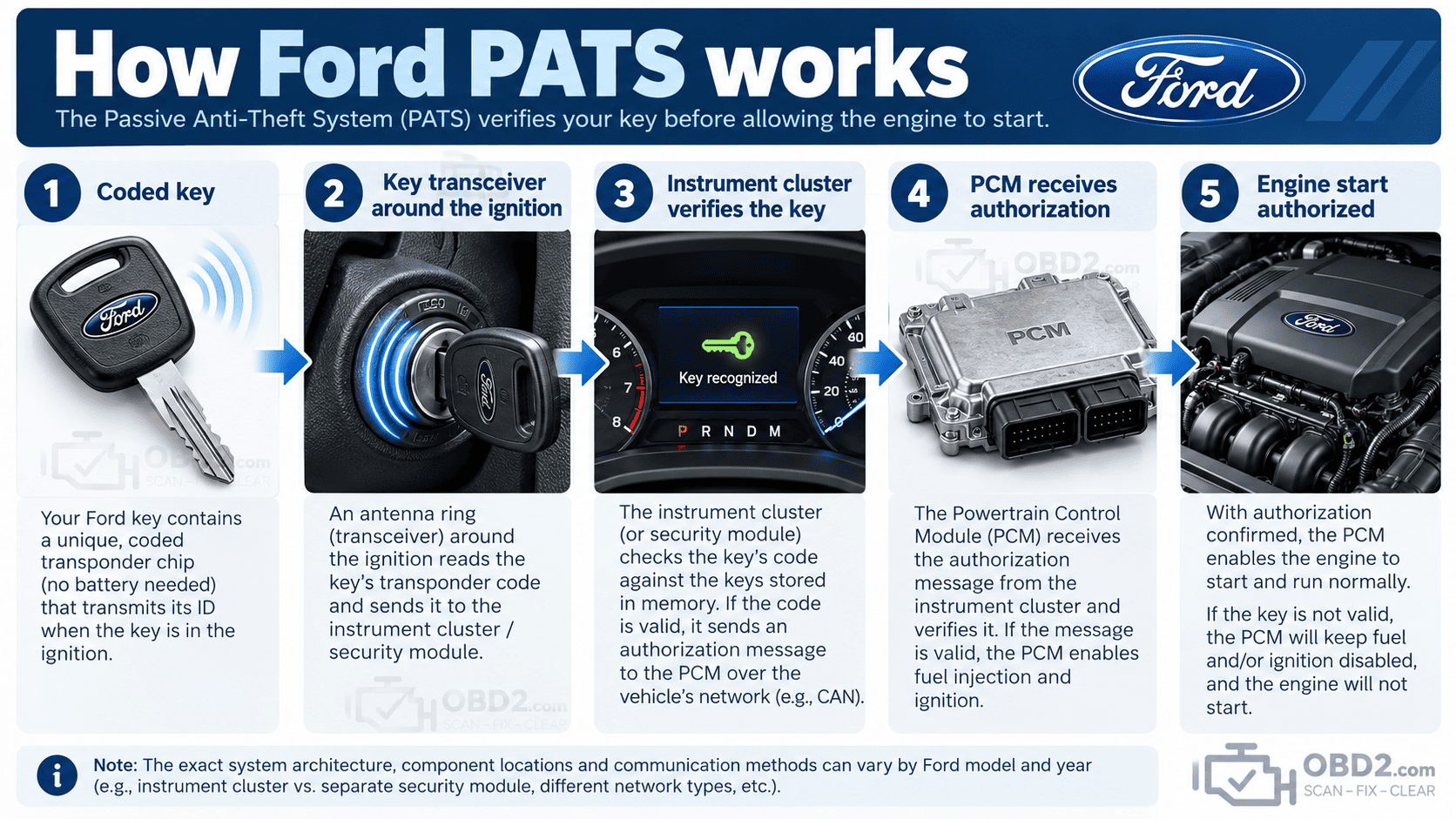
How Ford PATS works
PATS stands for Passive Anti-Theft System.
The vehicle checks whether the key being used is recognized and whether the modules involved in the immobilizer system agree that starting should be authorized.
Depending on the Ford platform, the system may involve:
- the coded ignition key or transponder;
- the key transceiver;
- the Powertrain Control Module (PCM);
- the Instrument Panel Cluster (IPC);
- a dedicated anti-theft module;
- a body or security control module;
- other modules participating in start authorization.
The exact architecture varies significantly between Ford generations, which is why a procedure that works on one model may be completely inappropriate on another.
When a PATS relearn or parameter reset may be needed
A PATS-related initialization procedure may become necessary after certain repairs or module replacements.
Typical examples include:
- PCM replacement;
- instrument cluster replacement;
- PATS or security-module replacement;
- certain module programming or configuration operations;
- replacement or addition of coded keys;
- repairs involving communication between PATS-related modules.
That does not mean every module replacement automatically requires the same PATS procedure. The requirement depends on the exact vehicle architecture and the module that was changed.
What a Ford PATS parameter reset does
A parameter reset is used on applicable vehicles to synchronize security-related information between modules participating in PATS.
A common example is PCM replacement.
The replacement PCM may contain the correct engine software and vehicle configuration but still not have security information that matches the other modules in the vehicle. In that situation, the engine may remain disabled until the applicable PATS initialization or parameter-reset procedure is completed.
This distinction is important because module programming and PATS initialization are not necessarily the same operation.
PCM programming and PATS are two separate steps
When a PCM is replaced on some PATS-equipped Ford vehicles, two different jobs may be required:
- PCM programming or configuration — installing the correct software, calibration and vehicle configuration;
- PATS initialization or parameter reset — synchronizing the security system so the vehicle can authorize starting.
Successfully programming the PCM does not automatically prove that the immobilizer side of the job has been completed.
A useful real-world clue is a vehicle that communicates normally with the replacement PCM and has the correct calibration installed, but still refuses to start and stores anti-theft-related information.
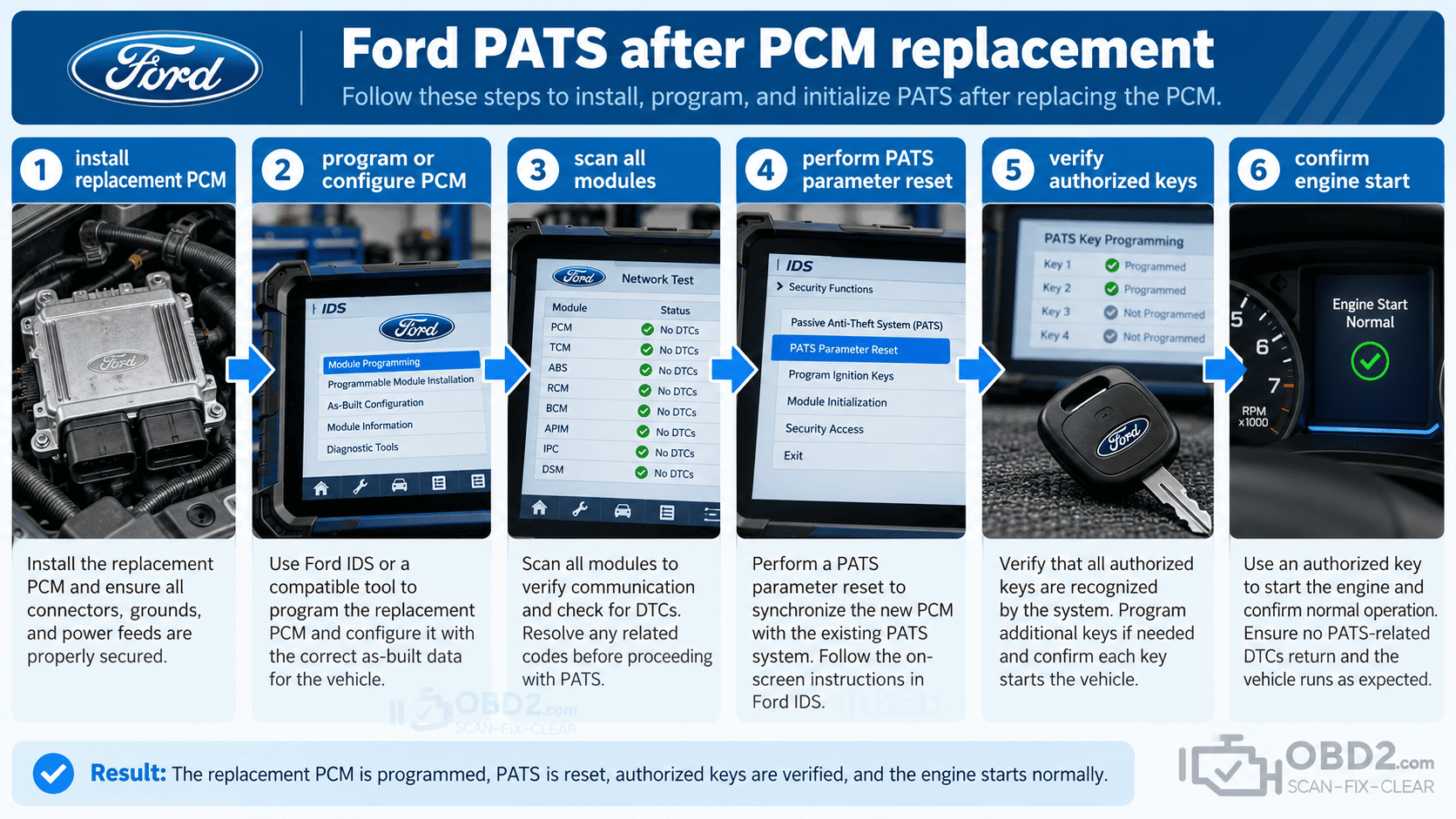
Ford PATS security access
Some Ford diagnostic procedures require access to a protected PATS security area before functions such as parameter reset or key programming become available.
Depending on the system and diagnostic software, a security waiting period or additional authorization step may be required.
This is normal behavior and should not automatically be interpreted as a communication problem.
Modern Ford procedures may also involve account-based authentication or other security controls. A diagnostic interface alone does not bypass those requirements.
How many keys are required?
The answer depends on the vehicle and the exact procedure.
Some Ford systems require two correctly coded keys for certain key-programming or module-replacement procedures.
Other systems allow additional-key programming under different conditions when one or more valid keys are already present.
This is one area where guessing can create unnecessary work. Before erasing or changing existing key information, check the service procedure for the exact vehicle.
What happens when PATS does not authorize starting?
The symptoms depend on the PATS generation and vehicle architecture.
You may see:
- engine cranks but does not start;
- engine does not crank;
- security indicator flashes rapidly;
- security indicator remains illuminated;
- PATS-related DTCs;
- PCM reports that starting has been disabled;
- communication faults between security-related modules.
Those symptoms tell you that start authorization may be involved, but they do not identify the failed component by themselves.
Common Ford PATS fault codes
PATS information can be stored in different modules, so reading only generic engine codes may give you only part of the picture.
P1260 — theft detected / vehicle disabled
P1260 commonly indicates that the PCM has disabled engine operation because of an anti-theft system condition.
It does not automatically mean that the PCM is faulty.
If P1260 is present, scan the PATS, cluster, body and other security-related modules for more specific information before replacing parts.
B1600 / B10D7 family
Depending on vehicle generation, Ford may use body or security DTCs for conditions involving an unrecognized key, key-programming issue, transceiver problem or another PATS-related fault.
Communication U-codes
If the modules involved in PATS cannot exchange the information required for start authorization, communication DTCs may be stored.
In that situation, repair the network or module communication problem before repeatedly attempting key programming or a parameter reset.
What to check before attempting a PATS relearn
Before assuming that programming is required, verify the basics.
- Check vehicle battery condition and voltage.
- Verify relevant module power supplies and grounds.
- Check PATS-related fuses.
- Perform a complete vehicle DTC scan.
- Confirm communication with the PCM and security-related modules.
- Inspect the key and transceiver where appropriate.
- Verify the replacement module part number.
- Confirm that the module has the correct vehicle configuration.
Low battery voltage, incorrect module configuration or a network fault can make a legitimate PATS procedure fail even when the key itself is perfectly good.
Why a complete vehicle scan matters
A basic generic OBD2 scan is often not enough for PATS diagnosis.
The useful fault information may be stored in the:
- PCM;
- instrument cluster;
- body control module;
- dedicated PATS module;
- gateway;
- another security-related controller.
A scanner capable of accessing Ford manufacturer-specific modules is therefore much more useful than a basic code reader when diagnosing an immobilizer problem.
For example, seeing only P1260 in the PCM tells you that starting was disabled. The code stored in another module may explain why it was disabled.
PATS is not basic OBD2
PATS functions are not part of the standard emissions-related OBD2 services.
A generic OBD2 reader may be able to retrieve an engine code associated with the no-start condition, but it normally cannot:
- enter Ford PATS security access;
- read every security-module DTC;
- perform a parameter reset;
- program replacement security-related modules;
- perform authorized key programming.
Those operations require suitable manufacturer-level diagnostic capability.
Can an ELM327 interface program Ford PATS?
An ELM327-type adapter is primarily a diagnostic communication interface.
Whether a particular adapter and software combination can access advanced Ford functions depends on several factors:
- adapter hardware;
- supported vehicle networks;
- software capability;
- vehicle generation;
- security-access requirements.
Do not assume that an interface capable of reading engine DTCs can also perform PATS procedures.
Reading generic OBD2 data and carrying out manufacturer-level security functions are very different capabilities.
A typical workflow after Ford module replacement
After replacing a PCM or another PATS-related module, a legitimate service workflow may look like this:
- Install the correct replacement module.
- Program or configure it according to Ford service information.
- Perform a complete scan and confirm communication with the relevant modules.
- Carry out the required PATS initialization or parameter reset.
- Confirm that the authorized keys are recognized.
- Clear relevant DTCs.
- Verify that the vehicle starts and operates normally.
The exact sequence can vary, so the diagnostic software and Ford service information should guide the procedure.
Ford PATS and J2534 Pass-Thru
Some Ford module-programming operations can use compatible J2534 pass-thru hardware.
J2534 provides a standardized communication interface between compatible programming software and the vehicle.
However, J2534 compatibility alone does not guarantee access to every Ford PATS or security function.
Security functions can have additional software, authorization and vehicle-specific requirements.
For a deeper explanation of pass-thru programming, see our J2534 Pass-Thru programming guide.
Why a PATS procedure may fail
If an authorized relearn or parameter-reset procedure does not complete, look beyond the key itself.
Possible causes include:
- low battery voltage;
- incorrect replacement module;
- incorrect module configuration;
- network communication faults;
- key transponder problems;
- key transceiver problems;
- incorrect procedure for the vehicle;
- software or driver compatibility problems;
- security-access requirements;
- existing DTCs preventing initialization.
A failed procedure is therefore a reason to diagnose the system, not to repeat the same programming attempt indefinitely.
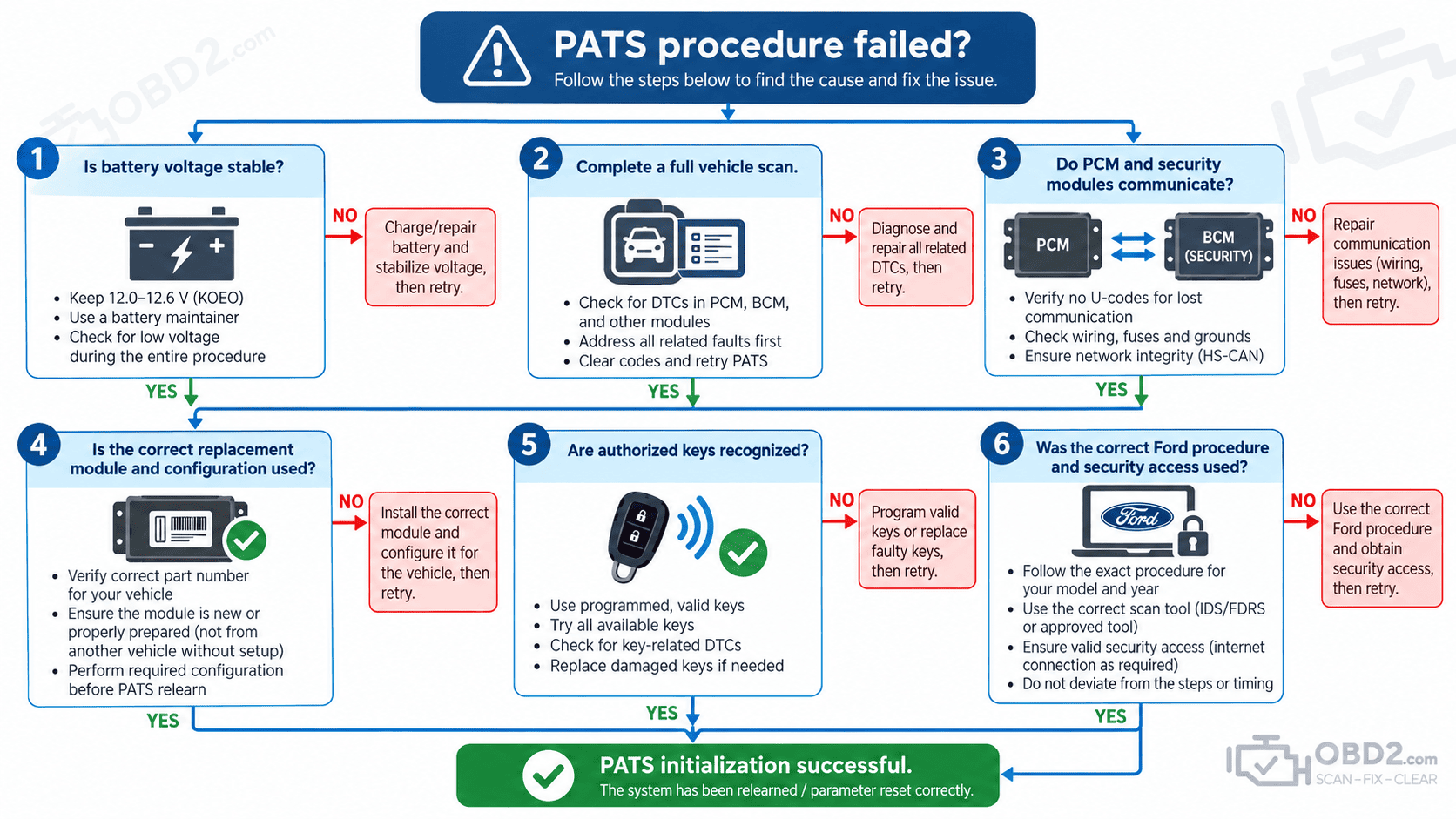
Battery voltage matters during programming
Stable vehicle voltage is important during module programming and security initialization.
A voltage drop can interrupt communication or programming and create additional faults that were not present before the repair began.
For professional module programming, use the battery-support procedure recommended by Ford for the applicable operation.
Do not treat PATS as a bypass problem
PATS is a vehicle security system.
Normal diagnosis should focus on identifying the fault and restoring authorized vehicle operation rather than defeating or bypassing the immobilizer.
For replacement keys, module replacement or ownership-related security work, follow Ford’s authorized service procedures and any applicable proof-of-ownership or security requirements.
Ford PATS FAQ
What does Ford PATS stand for?
PATS stands for Passive Anti-Theft System.
Can a bad key cause a Ford not to start?
Yes. If the system cannot correctly identify an authorized coded key, engine starting can be disabled.
Does a replacement PCM need a PATS reset?
On many PATS-equipped Ford vehicles, PCM replacement requires additional security initialization or a parameter reset. The exact requirement depends on the vehicle.
Why is the theft light flashing?
An abnormal security indicator can accompany a PATS fault, but the vehicle should be scanned for specific security-related DTCs before components are replaced.
Can a basic OBD2 scanner reset PATS?
Normally no. Generic OBD2 functions do not include Ford manufacturer-specific immobilizer programming.
Does P1260 mean the PCM is bad?
No. P1260 indicates that engine operation has been disabled because of an anti-theft condition. More specific PATS or communication faults should be investigated first.
Do I need two Ford keys?
Some PATS procedures require two coded keys, while others use different requirements. Check the exact Ford procedure for the vehicle before beginning.
Related diagnostic guides
- What is OBD2?
- J2534 Pass-Thru programming
- OBD2 connector & DLC pinout
- OBD2 DTC code library
- Diagnostic tools & OBD2 scanners
Ford technical references
Ford used several generations and configurations of PATS. Always use service information applicable to the exact VIN, model year and installed modules.
